

What to Look For in High-Quality Heavy Oversized Tees
Learn what to look for in high-quality heavy oversized tees, from GSM and fabric density to fit and wash care. Discover how to spot a tee that lasts.
Learn what to look for in high-quality heavy oversized tees, from GSM and fabric density to fit and wash care. Discover how to spot a tee that lasts.

Last Updated: September 29, 2026
Most shoppers judge a tee by how it feels on the hanger. That's the first mistake. Knowing what to look for in high-quality heavy oversized tees starts with the fabric itself, because weight and density decide how the garment ages. Knowing what to look for in high-quality heavy oversized tees starts with the fabric itself, because weight and density decide how the garment ages. Get those right and everything else, from drape to shape retention, follows.

Fabric weight is how heavy the cloth is per square metre, measured in grams per square metre (GSM). Fabric density is how tightly the yarns are knitted together. A tee can be heavy but loosely knit, which means it feels thick in the hand yet still wears thin over time.
A high GSM number on a tag tells you the cloth is heavy. It doesn't tell you the cloth is dense. Two tees can both read 240 GSM, yet one feels solid and opaque while the other pills and sags within a season.
Density is what gives a heavyweight cotton tee its structure. Tightly knitted cotton jersey holds its shape, resists stretching at the neckline and stays opaque. Loosely knitted fabric of the same weight loses all three.
So when you're comparing tees, don't stop at the number. Ask how the fabric is knitted, not just how heavy it is.
The best GSM for heavyweight t-shirts sits between 220 and 260 GSM for most everyday wear. Below 200 GSM, the fabric feels light and tends to go sheer under bright light. Above 280 GSM, a tee starts to feel like a sweatshirt and loses breathability.
Here's a simple way to think about it:
For an oversized silhouette, aim for the 220-260 GSM range. That's heavy enough to hold the boxy shape you want without turning stiff and uncomfortable.
Construction is where a heavy oversized tee proves itself. A great fabric can still be ruined by weak stitching, a flimsy neckline or a hem that twists after two washes.
Dropped shoulder construction means the shoulder seam sits lower down the arm rather than on top of the shoulder. This is what creates the relaxed, slouchy look of an oversized tee. When it's done well, the seam sits clean and flat. When it's done badly, it puckers and pulls.
Check the armhole depth too. A deeper armhole gives that relaxed fit without the fabric bunching under the arms.
The neckline is the first place a cheap tee fails. Look for a reinforced neck rib, which is a thicker band of ribbed fabric stitched around the collar. It should feel firm and spring back when you stretch it.
Neckline tension is the tell. A well-made collar returns to its shape instantly. A weak one stays stretched and gapes. This single detail separates a tee that lasts from one that sags quickly.
An oversized tee fit guide comes down to three measurements: chest width, body length and drape. Oversized does not mean shapeless. It means deliberately roomy in the right places, and the right proportions change depending on your height and build.
Start with chest width. Measure a tee you already like, lay it flat, and compare the pit-to-pit measurement to the size chart. For an oversized look, you usually want a chest width 5-8 cm wider than your standard fit. Then check proportionate length. A good oversized tee is longer than a standard tee but not so long it looks like a dress. As a rule, the hemline should sit around mid-fly to upper thigh.
Drape is the last piece. Heavy cotton jersey should fall in clean, soft folds rather than clinging or standing out stiffly. Drape is a product of fabric density as much as weight, a tightly knitted 240 GSM jersey drapes better than a loosely knitted 260 GSM one.
Most guides treat oversized as one look. It isn't. The same tee reads differently depending on your frame, and the adjustments you make should follow your proportions, not a trend.
Shorter frames (under about 170 cm). A deep drop shoulder and a long body can swallow your silhouette.
| Fit Goal | Chest Width | Body Length | Best For |
|---|---|---|---|
| Relaxed | +2-4 cm | Standard | Everyday wear |
| Oversized | +5-8 cm | +2-4 cm | Street style |
| Boxy | +8-10 cm | +4-6 cm | Layering, taller frames |
How to wash heavy cotton t-shirts without losing shape comes down to temperature and handling. Heat is the enemy of heavyweight cotton. It causes shrinkage and breaks down the fibres over time.
Follow these steps:
You can judge quality without touching the garment, using a visual inspection guide. Zoom in on product photos and look for specific signals before you buy. The trick is knowing which signals actually predict how a tee will wear after ten washes, and which are just marketing.
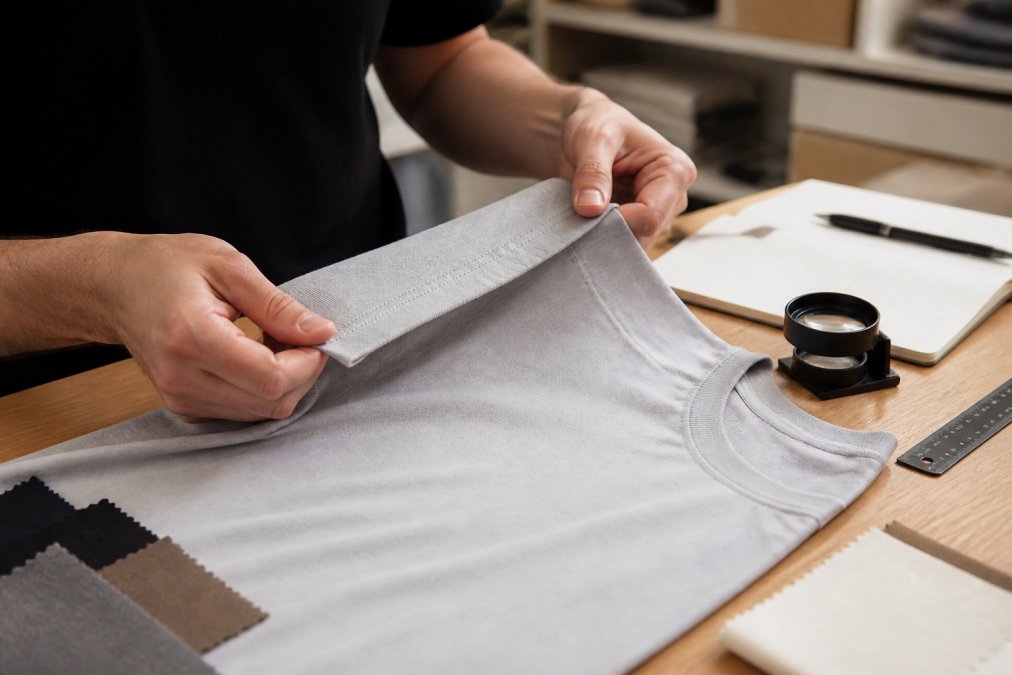
Stitch density at the hem and neck. A quality tee uses a tight, even stitch, usually a double-needle coverstitch at the hem and a twin-needle or bound finish at the neck. In a close-up photo, the stitches should look uniform and closely spaced. Widely spaced, wavy stitching is the first thing to fail after a few washes.
The size chart is a quality document, not just a fit guide. A maker confident in their fabric publishes chest width, body length, shoulder width and sleeve length, and often the GSM. If the chart lists only S/M/L with no measurements, treat that as a red flag.
Studio lighting flattens fabric texture. Natural-light photos reveal density far better, so look for at least one shot taken outdoors or near a window. Also check whether the maker shows the tee on more than one body type, a single model shot tells you very little about how the cut will sit on you.
The right fabric weight depends on where you live and how you wear it. A 260 GSM tee that feels perfect in a cool climate can feel heavy in the heat.
Urban Classics makes heavy oversized tees in black, white, grey and charcoal, all designed around fit, fabric and everyday wearability. No logos, no hype, just clean pieces that hold their shape.
Heavyweight tees typically start around 220 GSM and go up to 300 GSM or more. Below 200 GSM, fabric feels thin and can turn semi-transparent. For an oversized silhouette, aim for 240-280 GSM: heavy enough to hold a boxy shape and drape well, but still breathable for everyday wear. Anything over 300 GSM starts to feel stiff and is better suited to cooler months.
The shoulder seam should sit past your natural shoulder point, usually 3-6 cm down the arm. This creates the dropped shoulder look that defines an oversized silhouette. If the seam sits right on your shoulder bone, the tee is a regular fit, not oversized. Check that the armhole depth gives you room to move without the fabric bunching under the arms.
Look for pre-shrunk cotton jersey with a tight, even knit. Hold the fabric up to light: if you can see through it easily, the density is too low and it will stretch out. Check the neck ribbing too. A reinforced neck rib with good tension springs back when pulled. Seams should be straight and flat, not puckered or wavy.
Wash in cold water on a gentle cycle and skip the dryer. Heat is what causes shrinkage, so air-drying flat or on a line keeps the garment true to size. Turn the tee inside out to protect the surface, use a mild detergent, and avoid fabric softener, which coats the fibres and reduces breathability. Pre-shrunk fabric helps, but cold washing is still the safest habit.
Finding a heavy oversized tee that stays heavy after a year of washes is harder than it should be. Most brands cut corners on density and neckline construction, and the tee tells on them within months. Urban Classics builds clean basics around fit, fabric and shape retention, with reinforced neck ribbing, dense cotton jersey and a fit guide to help you get the silhouette right. Shop the Heavy Oversized Tee range and get a tee that looks the same on wash fifty as it did on day one.
Your cart is currently empty.
Start Shopping