

How to Find the Perfect Oversized Fit
Learn how to find the perfect oversized fit with our guide on shoulder seams, fabric weight, and proportions. Discover oversized t-shirt styling tips.
Learn how to find the perfect oversized fit with our guide on shoulder seams, fabric weight, and proportions. Discover oversized t-shirt styling tips.

Last Updated: September 6, 2026
Finding the perfect oversized fit is about understanding garment construction, not just picking a larger size. The best oversized pieces look intentional, with clean lines that drape over the body rather than swallow it.

An intentionally oversized fit is a design choice where the garment is cut with extra room in the body and sleeves while maintaining structure through the shoulders and hem. Baggy clothes collapse with no defined shape, while oversized pieces hold their form and create a deliberate, boxy silhouette.

Look for these markers of an intentional cut:
If a garment bunches excessively at the underarms or sags at the hem, that is a fit problem, not a style choice. The oversized aesthetic works when the fabric falls smoothly from defined points.
The first step is taking your actual measurements, because oversized sizing charts shift dramatically between brands. A size XL from one label might match a size M from another.
Grab a soft tape measure and record these points:
Compare these numbers against the size chart for the specific garment you want. The best oversized fit typically adds 10 to 15 centimetres of chest room and 5 to 8 centimetres of length compared to your regular fit measurements (fashion-schools.org). This creates that relaxed fit without turning the piece into a dress.
The shoulder seam is the single most important detail in an oversized garment, because it anchors the entire silhouette. On an intentionally oversized tee, the shoulder seam should sit 2 to 5 centimetres past your natural shoulder point, creating a dropped shoulder effect that reads as deliberate.
Sleeve length follows the shoulder drop. When the seam moves down your arm, the sleeve needs extra length to match, typically ending mid-bicep rather than at your wrist. Check the armhole depth too: a proper oversized cut has a deeper armhole that lets the sleeve hang freely without pulling across your chest.
Look at how the side seams run: they should fall straight down from the underarm without curving inward. A boxy cut with straight side seams produces that clean, structured look, while curved seams indicate a more fitted piece that will fight you when you size up.
Fabric weight determines whether an oversized garment drapes elegantly or collapses into a shapeless heap. A heavy fabric, typically 180 to 240 GSM, holds its structure and creates that crisp, boxy silhouette that defines the oversized aesthetic (fabriclink.com).
Lightweight fabrics below 150 GSM are harder to wear oversized because they cling to your body and wrinkle easily. Medium weights around 160 to 180 GSM work for relaxed fits but lack the structure for a true boxy cut. The drape you want comes from the interaction between the cut and the cloth: heavy cotton with a tight weave gives you clean lines, while softer, looser weaves produce a more fluid look.
Sizing up in a flimsy t-shirt does not create an oversized fit, it creates a garment that hangs limply with no shape. Look for fabric that snaps back when stretched and holds a crease when folded.
Oversized tops require careful bottom choices to keep your outfit balanced rather than overwhelming. The golden rule is to pair a voluminous top with a tapered or slim bottom, creating visual balance through contrast.
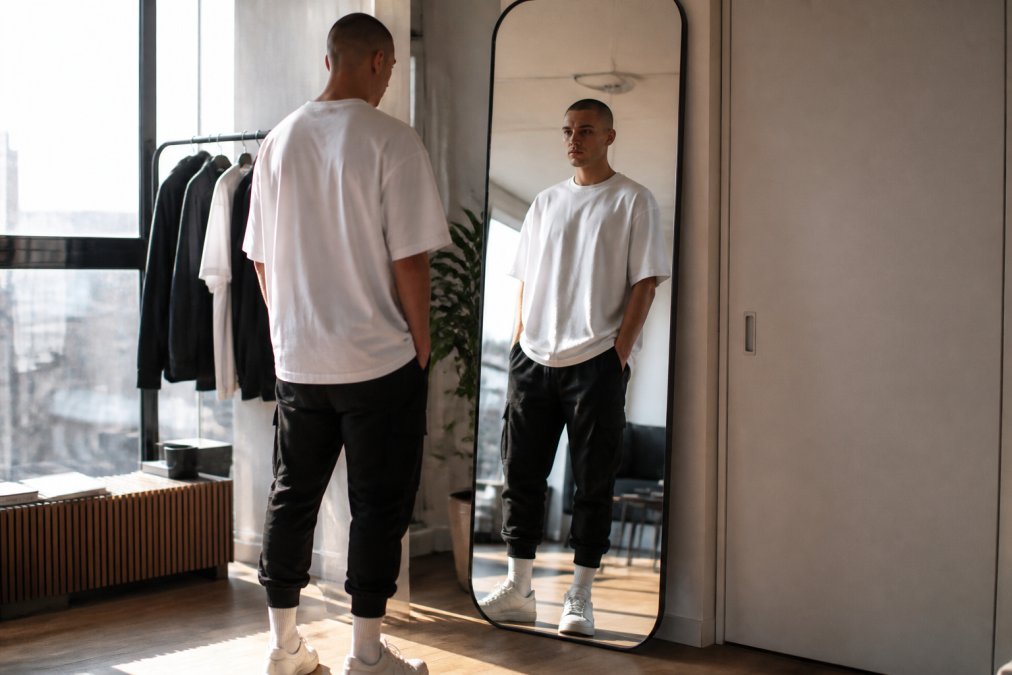
Consider these combinations for a cohesive look:
If your oversized top falls past your hips, keep your bottoms fitted through the leg to avoid looking shapeless. If the top is cropped or hits at the waist, you have more freedom to experiment with wider trousers.
The real lever is the relationship between your shoulder width and the garment's shoulder drop, measured in centimetres. Here is the technical breakdown for the two extremes, petite and tall.
For a shorter torso, the enemy is vertical overload. A standard oversized tee with a 10 cm shoulder drop and a 75 cm body length will visually cut your legs in half. The fix is not to avoid oversized, it is to control the drop and the hem.
Taller bodies have the opposite problem: standard oversized cuts often fit like a regular tee because the proportions scale down relative to your frame.
Regardless of height, there is one test that separates an intentional oversized cut from a sizing error. Put the tee on and raise your arms to shoulder height. If the hem rises more than 2-3 cm at the sides, the armhole is too shallow for the body width, this is a fitted cut that has been sized up, not an oversized cut. A true oversized garment has a deep armhole (often 25-30 cm from the shoulder seam to the underarm) that allows full arm movement without pulling the hem.
:::tip Visual check Stand sideways in front of a mirror. The fabric should fall in a straight line from the chest to the hem. If it curves inward at the waist, the garment is not cut oversized, it is just loose. :::
The perfect oversized fit means nothing if the garment shrinks in the first wash. Most shrinkage happens because of heat: hot water causes cotton fibres to tighten, and high dryer heat sets that shrinkage permanently.
Wash your oversized pieces in cold water, ideally at or below 30 degrees Celsius, and skip the dryer entirely (textileinstitute.org). Lay the garment flat to dry or hang it on a padded hanger to preserve the shoulder shape. When you do use a dryer, keep it on the lowest heat setting and remove the garment while it is still slightly damp.
Heavy-weight cotton holds its shape better than lighter knits across multiple washes. A well-constructed oversized tee in durable fabric will maintain its drape and structure over time, while cheaper options tend to thin out and lose their boxy cut.
The most common mistake is sizing up in a garment that was never cut to be oversized. A second error is misreading vintage and thrift sizing.
When you buy a regular-fit tee two sizes up, the shoulder seam slides down your arm, the armhole digs into your armpit, and the side seams bow outward because the chest width was never adjusted. The result collapses at the waist and bunches at the underarms.
An intentionally oversized garment is cut with a straight side seam from the underarm to the hem, a wider chest panel, and a deeper armhole, all designed together. If the side seam curves inward at the waist, it is a fitted garment. Walk away.
Australian vintage clothing from the 1980s and earlier uses a sizing system that predates modern vanity sizing. A vintage size M often corresponds to a modern XS or XXS in chest and shoulder measurements.
A vintage 'large' tee might have the chest width of a modern medium but the shoulder width of a modern small. Buying it for an oversized fit gives you a garment tight across the back and loose through the body.
The translation rule for vintage:
There are at least three distinct oversized silhouettes:
Buying a longline cut expecting a box gives a tunic-like hang. Buying a box expecting a drop shoulder gives a stiff, wide shape that does not drape. Read the product description for the specific silhouette.
A 220 GSM cotton tee will shrink 3-5% in the first wash with hot water, a 1-2 cm reduction in chest and length, enough to turn a perfect oversized fit into a regular fit. Check the care label: 'warm wash' or 'tumble dry low' means the fabric is likely pre-shrunk; 'cold wash only' means it will shrink on first wash.
:::warning The 2 cm rule When measuring a thrift or vintage piece, add 2 cm to the chest and 2 cm to the body length if the fabric is unwashed cotton. This accounts for the first-wash shrinkage that the previous owner never triggered. :::
An intentionally oversized fit is a design choice, not an accident. Check the shoulder seam: if it sits well past your natural shoulder point and the body of the shirt falls straight with a boxy cut, it's intentional. The fabric weight should be substantial enough to hold the shape. In contrast, a poorly fitting garment often has an uneven hemline, tight armholes, and a drape that looks sloppy rather than structured.
Sizing up as a shortcut often creates the wrong proportions, especially in the shoulders and armholes. Instead of sizing up, look for garments with an 'oversized fit' or 'boxy cut' label, which are designed with wider measurements from the start. If your usual size fits in the shoulders but feels too tight in the body, then sizing up once is acceptable. Always compare the garment's flat measurements to your own.
Yes, fabric weight is the single most important factor. Heavy-weight cotton, around 240gsm, is ideal for an oversized tee because it drapes with structure and holds its shape. Lightweight fabrics cling to your body and can look baggy rather than fashionably oversized. A heavier fabric also prevents the garment from losing its shape after washing, which is a common issue with cheaper basics.
The rule is simple: pair an oversized top with a tapered bottom. Wide or baggy trousers with an oversized tee can make you look swamped. Instead, choose tapered joggers, slim-fit jeans, or shorts that end above the knee. This creates visual balance by framing the loose upper half against a more fitted lower half, keeping the silhouette sharp and intentional.
Finding the perfect oversized fit is a skill that rewards attention to detail, and the right basics make it effortless. Urban Classics builds our heavy oversized tees with a true oversized cut, heavy-weight cotton, and construction designed to hold its shape wash after wash. Shop the collection online with free shipping on orders over $50 and get started with Urban Classics for that boxy, street-ready silhouette you have been chasing.
Your cart is currently empty.
Start Shopping