

Why Premium Basics Last Longer: A 2026 Guide
Why premium basics last longer: explore fabric quality, cost per wear and care tips. Discover how to build a wardrobe that endures. Start shopping smarter.
Why premium basics last longer: explore fabric quality, cost per wear and care tips. Discover how to build a wardrobe that endures. Start shopping smarter.

Last Updated: September 11, 2026
Premium basics last longer because their fabric uses longer cotton fibres, is woven more densely, and is finished to resist shrinkage and pilling. That difference is measurable, a $49 tee can outlast three cheap ones. This guide breaks down the fabric science, construction details, and cost per wear maths behind premium basics.
Most shoppers judge a tee by feel in the change room, which tells you almost nothing. The real signals are fibre length, fabric weight, and stitching.
Long-staple cotton has fibres long enough to spin into stronger, smoother yarn with fewer exposed ends, less pilling, less fuzz, better shape retention after repeated washes.
Short-staple cotton is cheaper to grow and process, but its yarn frays, pills, and thins faster under friction. A heavy oversized tee made from long-staple cotton holds its structure while a budget equivalent goes limp.

Fiber density works alongside fibre length: denser yarn packs more fibre into the same space, raising tensile strength and slowing degradation. You cannot see density on a label, but you can feel it, denser fabric resists light and holds a crisp drape.
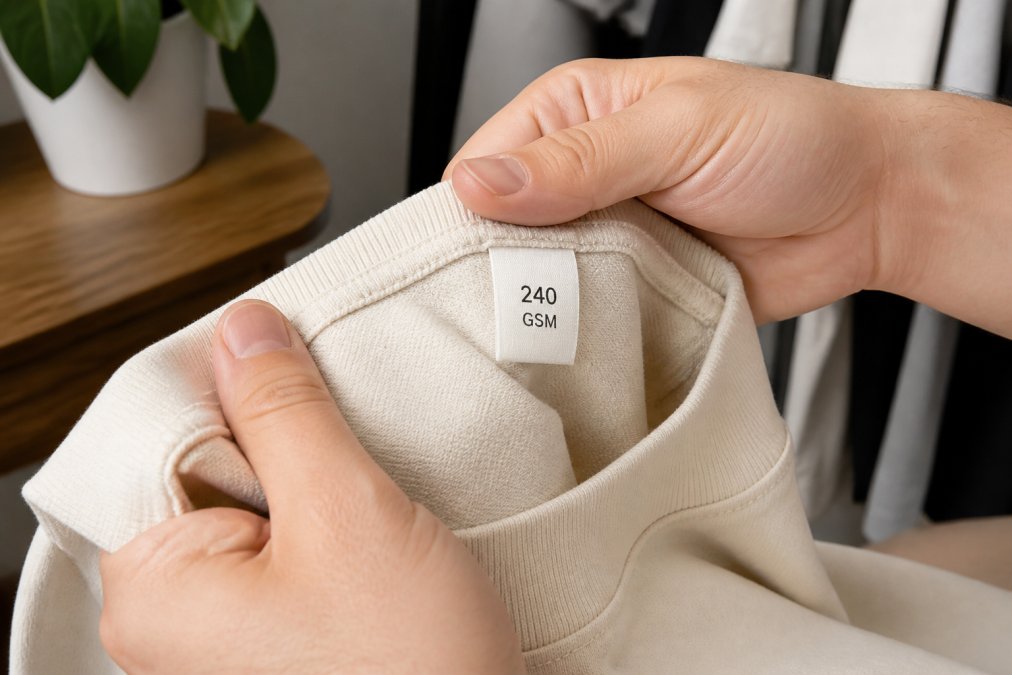
Fabric weight is measured in GSM, or grams per square metre. A 180 GSM tee feels light and drapes loosely. A 240 GSM tee feels substantial and holds its shape through repeated wear.
Higher GSM does not automatically mean better quality, but it does mean more material per square centimetre to absorb friction before the fabric thins. For streetwear, heavier fabric also holds the oversized shape instead of collapsing at the shoulders.
| GSM Range | Feel | Best For | Durability Signal |
|---|---|---|---|
| 140-160 GSM | Light, thin | Layering, warm weather | Low, prone to thinning |
| 180-200 GSM | Standard | Everyday basics | Moderate |
| 220-260 GSM | Heavy, structured | Oversized streetwear | High, holds shape |
| 280+ GSM | Very heavy | Cold weather, statement fits | Very high |
Fabric gets the attention, but construction is where most garments fail. A heavy-weight cotton tee with a weak shoulder seam will outlive its fabric by nothing, the seam goes first. Two systems decide whether a basic survives: the seam and the hardware.
Stitch density is measured in stitches per inch (SPI) along a seam, the most useful number a shopper can estimate by eye.
For a cotton tee or hoody, 10-12 SPI at the shoulder, neck rib and hem is the benchmark. Count stitches across a 25 mm span with a ruler and phone camera zoom, it takes about thirty seconds.
Seam type matters as much as density:
Inspect stress points in this order: shoulder seam, neck rib join, armhole, side seam at the underarm, and hem. If the shoulder seam looks thin, puckered or shows gaps when stretched, the garment will fail there regardless of fabric quality.
Hardware is where cost-cutting is most aggressive and least visible. A garment can use excellent long-staple cotton and still be scrapped because a zip failed. The failure modes are predictable.
Zips. Metal zips (brass, aluminium, nickel) outlast plastic moulded zips, but the tape and slider matter more than the teeth material. A YKK zip is the benchmark because tolerances are tight and sliders are interchangeable. Look for:
Buttons and snaps. Plastic buttons can crack at the shank under stress; corozo (tagua nut) and metal buttons often hold up better. Check the button is attached with a cross-stitch or shank, not a single thread loop, which can be a failure point.
Eyelets and drawcord tips. Metal eyelets should be set with a rolled edge rather than a flat washer to resist pull-through; rust signals low-grade plating. Heat-sealed (aglet-style) drawcord tips survive washing; glued tips can separate within a few cycles.
Elastic. Waistbands and cuffs use woven or knitted elastic. Knitted stretches more but fatigues faster; woven holds tension longer. Either way, elastic is often the first component to fail on a hoody cuff or tracksuit waist.
Thread. Cheap garments often use cotton-wrapped polyester thread that can abrade and snap. Quality construction uses corespun polyester thread, a polyester core for strength with a cotton or polyester wrap. Under light, corespun thread has a slight sheen and does not fray at the cut end.
Run this sequence before buying any basic with hardware:
Cost per wear is the purchase price divided by the number of times you wear the item. A $49 tee worn 100 times costs $0.49 per wear; a $20 tee worn 15 times before losing shape costs $1.33.
The formula is simple:
Cost per wear = Purchase price ÷ Number of wears before replacement
Apply it honestly. Most people overestimate how long cheap basics last, because the decline is gradual.
| Garment | Price | Wears Before Replacement | Cost Per Wear |
|---|---|---|---|
| Budget tee | $20 | 15 | $1.33 |
| Mid-range tee | $35 | 40 | $0.88 |
| Urban Classics Heavy Oversized Tee | $49 | 100+ | $0.49 |
| Urban Classics Organic Basic Hoody | $99.95 | 150+ | $0.67 |
This is the core argument for premium basics: the higher upfront price is a deposit on longevity. Run the calculation before dismissing a $49 tee as expensive.

How to care for streetwear basics comes down to three rules: wash cold, wash less, and dry flat. Heat is the primary cause of shrinkage and fibre damage; cold water preserves fibre structure and slows colour loss (PubMed).
Practical care routine:
Pre-washed fabric shrinks less because the mill has already done the initial contraction. If a brand does not pre-wash its cotton, expect the first wash to change the fit.
Long lasting basics for men come down to four checks you can run in under a minute, no lab, just your hands and eyes.
Urban Classics builds its range around these markers. The Heavy Oversized Tee - Black is cut from heavy-weight cotton with a structured drape that holds the oversized fit, and the Organic Basic Hoody - Black uses organic cotton with reinforced seams for daily rotation. Both are priced to make the cost per wear maths work in your favour.
Most articles stop at "buy less, buy better", a slogan, not a mechanism. The environmental case for premium basics only holds up when you can explain what happens to a garment at the molecular level during dyeing, washing and disposal, and why a longer service life changes the maths.
Colour loss is usually the first visible sign a basic is degrading, and it has almost nothing to do with wash frequency. It comes down to how the dye bonds to the fibre.
Low-cost production often skips the soaping-off stage that removes unfixed dye. The garment looks correct on the shelf, then can bleed for its first few washes and fade unevenly.
Indigo and sulphur dyes behave differently, indigo is a vat dye that sits partly inside the fibre and is designed to abrade, which is why raw denim fades as it does. For basics, reactive dyeing is the benchmark.
Every wash cycle sheds fibre fragments into wastewater. The volume correlates with two things: how many short fibres are exposed at the yarn surface, and how much mechanical agitation the fabric receives.
Long-staple, tightly spun yarn presents fewer loose fibre ends, so less material can break off. Short-staple yarn is the opposite, a forest of loose ends that each wash knocks free. It is the same mechanism behind pilling, viewed from the wastewater side.
What this means practically:
"Buy it for life" and "recycle it" are often presented as competing philosophies. They are not, they are sequential stages of the same garment's life, and the order matters.
A cotton tee that lasts longer before becoming a cleaning rag, then a textile-recycling input, has displaced fast-fashion equivalents, avoided cotton cultivation, dyeing, cutting, sewing and freight. The durability gain compounds because it happens at the front of the chain, where environmental cost is concentrated.
Recycling sits at the back of the chain. Mechanical recycling shreds fabric back into fibre but shortens staple length, so recycled cotton must be blended with virgin fibre to be spinnable (peer-reviewed research). Recycling recovers material but does not fully close the loop, it delays rather than eliminates the need for new cotton.
The practical hierarchy most textile practitioners work to is: wear longer, repair, repurpose, then recycle. Premium basics win on the first step, which is the only step that avoids new production entirely.
The mental benefit of a curated wardrobe comes from three concrete effects:
None of this requires a minimalist aesthetic. It requires garments that do not force themselves back onto your to-buy list every few months.
The hardest part of upgrading your wardrobe is trusting a higher price will pay off. It does when the garment is built with long-staple cotton, higher GSM, dense stitching and durable hardware. Urban Classics stocks heavy oversized tees, organic hoodies and heavyweight jumpers built around those markers, with bundle pricing and free shipping on orders over $50. Get started with Urban Classics and build a rotation of premium basics that holds its shape.
The 3-3-3 rule is a guideline for building a versatile wardrobe: own three tops, three bottoms, and three pairs of shoes that can mix and match for any casual occasion. It encourages buying fewer, higher-quality items that last longer and reduce decision fatigue. For premium basics, this means choosing durable fabrics and classic fits that withstand frequent wear and washing.
Not always. Long-staple cotton can offer good durability because its fibres are stronger and resist pilling. However, polyester blends can add durability and shape retention, especially in activewear. The key is fabric quality and construction: a heavyweight 100% cotton tee with dense stitching can offer good longevity. Check GSM and stitch density for real longevity.
Look for tight, even stitching (8-12 stitches per inch), reinforced seams at stress points, and natural fibres like long-staple cotton. Check the fabric weight: heavier GSM (180+ for tees) indicates durability. Also inspect hardware like zippers and buttons for solid feel. Pre-washed fabrics resist shrinkage. These signs can help identify durable basics.
Yes, when you calculate cost per wear. For example, a $49 premium tee worn 100 times costs $0.49 per wear, while a $15 fast-fashion tee worn 20 times costs $0.75 per wear. Premium basics can also retain shape and colour longer, potentially reducing replacement frequency. Over time, investing in durable pieces can save money and reduce textile waste, aligning with sustainable fashion principles.
Your cart is currently empty.
Start Shopping